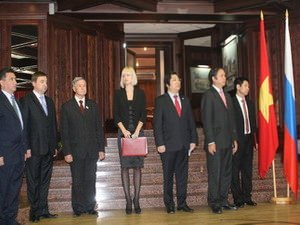
Image of the Consulate General of Vietnam in the Russian Far East
The Russian Far East is a vast region covering 36.1% of Russia’s territory, endowed with abundant and diverse natural resources such as oil and gas, coal, gold, iron ore, diamonds, fish, forests, and medicinal plants. However, the population of the Far East is very sparse, numbering only 6.4601 million people (as of January 2009), and the trend continues to decline.
The Far Eastern Federal District consists of nine provincial-level administrative units: Primorsky Krai with Vladivostok as its capital, Khabarovsk Krai with Khabarovsk as its capital, Kamchatka Krai, Amur Oblast, Sakhalin Oblast, Magadan Oblast, the Jewish Autonomous Oblast, Chukotka Autonomous Okrug, and the Republic of Sakha (Yakutia). This is a remote region of the Russian Federation, located more than 9,000 kilometers from Moscow.
The Vietnamese community in the Far East consists of nearly 4,000 people, many of whom were originally workers sent under labor cooperation agreements between Vietnam and the Soviet Union in the 1980s. In addition, as the saying goes, “birds flock to fertile land,” the number of Vietnamese coming to live and work here has steadily increased. Most community members belong to this later group.
Vietnamese people mainly live and work in two localities: Primorsky Krai and Khabarovsk Krai. In Khabarovsk City, the capital of Khabarovsk Krai, there are about 1,500 Vietnamese people, while Vladivostok City and the two towns of Artyom and Nakhodka are home to approximately 1,700 people. Vladivostok is about 800 kilometers from Khabarovsk. In addition, more than 30 Vietnamese live in Blagoveshchensk, the capital of Amur Oblast.
Regarding legal status, the majority of the Vietnamese community in Khabarovsk possesses legal documentation. In Vladivostok, however, relatively few community members have official residential registration. Most registrations are valid for one year, while about 40% have three-year registrations. This situation stems from the fact that many people do not fully appreciate the importance of establishing stable residency and often maintain a temporary mindset: stay if possible, return to Vietnam if not. Moreover, some feel that paying a small amount to the police is cheaper than obtaining legal registration, leading them to avoid official procedures. Furthermore, residential registration is linked to employment categories. Since most Vietnamese engage in commerce, obtaining work permits is difficult because commercial activities are largely closed to foreigners. Recently, the Consulate General, the Far East Party Committee, and the Vietnamese Association have recognized this issue and continuously encourage community members to pay greater attention to legalization, as stable residency is essential for building a stable future.
Regarding employment and occupations, the vast majority of Vietnamese are engaged in trade, primarily selling goods in local markets. A significant number work in construction, while others provide services. The number of businesses owned by Vietnamese remains relatively small.
In Khabarovsk, as elsewhere, most Vietnamese engage in market trading. Approximately 300–400 people work in construction, while others are employed in service industries. Although incomes are not particularly high, they are relatively stable. Two successful enterprises stand out: Golden Saigon Company, owned by Mr. Le Xuan Thom, and Business-Contact Co., Ltd., owned by Mr. Thai Khac Viet.
Mr. Viet’s company is primarily involved in construction while also operating dormitories for Vietnamese workers and providing accommodation and documentation services. In addition, he owns a large automobile repair workshop employing dozens of Vietnamese workers. Mr. Thom’s company also provides dormitory and documentation services. Furthermore, Mr. Thom has invested in Nha Trang, Khanh Hoa Province, owning a mid-range hotel and a restaurant. Thanks to the efforts of Mr. Thom and Mr. Viet, Vietnamese residents can rent housing at affordable rates, enjoy stable living conditions, and live in concentrated communities, making community organization and mobilization easier. Thanks to these enterprises, together with support from local authorities, almost all Vietnamese residents possess valid documents and enjoy stable living conditions.
Khabarovsk is home to several universities; however, only about six or seven Vietnamese students, mainly children of local Vietnamese families, are currently studying there.
The Vietnamese community in Khabarovsk is well organized through hometown associations. Community life is disciplined and structured, with strong awareness of collective responsibility and attachment to the homeland. Negative phenomena such as drug abuse, gambling, conflicts, and unfair competition are virtually absent. The association regularly organizes activities directed toward Vietnam and friendship with local residents and enjoys considerable respect from local leaders and citizens. Events such as the celebration of Vietnam’s National Day on September 2, 2009, and football tournaments attracted around 1,000 participants. Community members also actively participated in the naming ceremony of a vessel after President Ho Chi Minh in April 2010. A Women’s Association has been established. Although many young people participate in community activities, their organization remains informal and has not yet been officially recognized by the Youth Union Representative Committee in Moscow. The local Party Cell consists of ten members, led by Mr. Nguyen Duc Khiem as Secretary and Mr. Thai Khac Viet as Deputy Secretary, both highly respected and effective leaders.
In Vladivostok, Artyom, and Nakhodka, most Vietnamese residents are also market traders. At Pervaya Rechka Market, for example, almost all stalls are operated by Vietnamese merchants. In addition to traders, approximately 3,000–4,000 Vietnamese construction workers are employed on APEC-related projects. This number continues to grow due to the strong demand for construction labor. Vladivostok also hosts several Vietnamese-owned enterprises, including the Grand Trade Center, Agrimex Company, and Nhat Minh International Travel Company. Most Vietnamese businesses, however, remain small enterprises.
Primorsky Krai also has a strong Vietnamese Association headed by Mr. Nguyen Duy Thanh. In addition, there are branches of the Ho Chi Minh Communist Youth Union, the Women’s Association, and the Student Association (with nearly 40 students), all affiliated with the Vietnamese Association. There is also a Party Cell with six members, serving as the leadership nucleus of the community. Its Secretary is Mr. Nguyen Van Dong, who also serves as Deputy Secretary of the Far East Party Committee.
The Vietnamese Association in Primorsky Krai maintains excellent relations with local authorities and with the Executive Committee of the Russia–Vietnam Friendship Association of Primorsky Krai. It actively participates in activities aimed at strengthening and developing friendship between Vietnam and the Russian Federation, as well as between Vietnam and the Russian Far East.
In summary, although the Vietnamese community in the Russian Far East is not large, it serves as an important bridge for the traditional friendship and cooperation between Vietnam and the Far East. The community has made meaningful contributions to the development of economic, trade, cultural, educational, and training relations between the two sides.
Local authorities generally treat the Vietnamese community with friendship and goodwill. However, residency policies remain very strict. Legal residency is closely tied to legal employment, and since April 2007, when the Russian Government prohibited foreigners from trading in markets, obtaining residential registration has become even more complicated.
Therefore, the greatest challenge facing the community remains legalization. The Far East Party Committee, the Consulate General, and the Vietnamese Association have made considerable efforts to help community members obtain legal status and establish stable residency. However, results remain limited, especially in Vladivostok. A fundamental solution to this issue requires action at the national level.